Knowing how to dice an onion is the most useful knife skill in any kitchen. Almost every soup, sauce and stew starts with one, and one simple method works for every onion.
This guide walks through it step by step, explains how to choose your dice size, and covers what research actually says about crying less. We make 1000 Cuts, a fruit slicer game that has an onion in it, so we spend a lot of time thinking about how onions come apart.
What you need
You need a sharp chef's knife and a stable cutting board. That's it.
- A sharp knife. It slices the layers instead of crushing them, which also means fewer tears (more below).
- A board that doesn't slide. Put a damp cloth or paper towel under it so it stays put.
- A free hand in a claw. Curl the fingertips of your holding hand under, so your knuckles face the blade and your fingertips are tucked away.
How to dice an onion, step by step
The method has five steps, and the secret is the root. The root end holds all the layers together while you cut, so the onion doesn't fall apart until the very last slice.
- Trim the top, keep the root. Cut a thin slice off the pointy top (the stem end). At the other end, shave off only the hairy roots and leave the root plate whole.
- Halve it through the root. Stand the onion on its flat top and cut straight down through the middle of the root. Each half keeps a piece of root.
- Peel. Pull off the papery skin and the first tough layer if it's dry or bruised. Lay each half flat side down.
- Make vertical cuts. With the root pointing away from you, slice down lengthwise from just in front of the root to the top end, keeping the tip of the knife pointing towards the root. Don't cut through the root. Space the cuts as wide as you want your dice.
- Slice across. Turn the half so the cuts run left to right, and slice across them, working towards the root. The cubes fall away as you go. Stop when you reach the root and save it for stock or the bin.
Is the horizontal cut necessary?
No, the horizontal cut is optional. Many chefs make one to three flat cuts into the side of the half, parallel to the board and stopping short of the root, before slicing across. It cuts the tall bottom layers into smaller pieces, so the cubes come out more even.
But an onion is already made of layers, so those layers act like built-in horizontal cuts. For a home cook, skipping the horizontal cut gives a perfectly good dice and keeps your hand further from the blade. If you do make it, keep your holding hand flat on top of the onion and well behind the knife's path.
Dice sizes: small, medium and large
The size of your dice is set by the gap between your cuts. Here's a simple guide:
| Size | Gap between cuts | Good for |
|---|---|---|
| Fine (mince) | about 3 mm | Dressings, salsas, quick sauces |
| Small | about 6 mm | Soups, risotto, burgers |
| Medium | about 1 cm | Stews, chilli, curries |
| Large | about 2 cm | Roasting, kebabs, long braises |
Smaller pieces cook faster and melt into a sauce. Bigger pieces keep their shape and some bite. If a recipe just says "diced", medium is a safe choice.
Why onions make you cry
Onions make you cry because cutting them releases a gas that irritates your eyes. Inside an intact onion, the sulphur compounds and the enzymes that act on them are kept apart in different parts of the cells. A knife breaks the cells open, the two meet, and the reaction makes a volatile chemical called syn-propanethial-S-oxide. When it reaches your eyes, they make tears to wash it away.
Researchers in Japan identified the enzyme behind this step, called lachrymatory factor synthase, in a 2002 paper in Nature.
How to cut an onion without crying: what the science says
The best evidence points to two simple things: a sharp knife and calm, steady cuts. In 2025, a Cornell University team led by Zixuan Wu and Sunghwan Jung filmed onions being cut by blades of different sharpness at different speeds, and published the results in PNAS.
They found that each layer bursts out a fine mist of droplets the moment the blade breaks through it. Blunter blades and faster, more forceful cuts produced much more of that spray, and the droplets shot out far faster than the blade itself was moving. A sharp blade cutting steadily kept more of the mist low, below eye level. The starting temperature of the onion made no real difference, which goes against the popular tip of chilling it first.
What that means in your kitchen:
- Sharpen your knife. It's the single change with the best evidence behind it.
- Cut steadily, not violently. A smooth slicing motion beats hacking down hard.
- Keep the root on until the end. Fewer cut layers means fewer bursts of mist, and the root keeps the onion together so you finish faster.
- Move the air. Cutting near an open window or under a running extractor fan moves the vapour away from your face.
- Goggles do work. Swimming or onion goggles that seal around your eyes stop the gas reaching them.
Folk tips like holding bread or a match in your mouth come up a lot, but we found no good evidence for them.
Dicing on a screen: the tear-free version
If you love the rhythm of dicing but not the tears, there's a tear-free version on your phone. Onion is one of the seven real 3D scanned fruits in 1000 Cuts, our satisfying game for Android. You tap to chop exactly where you touch, then turn the board with ⟲ ⟳ or a two-finger twist and cut across your earlier slices. That's the same "down, then across" idea as a real dice.
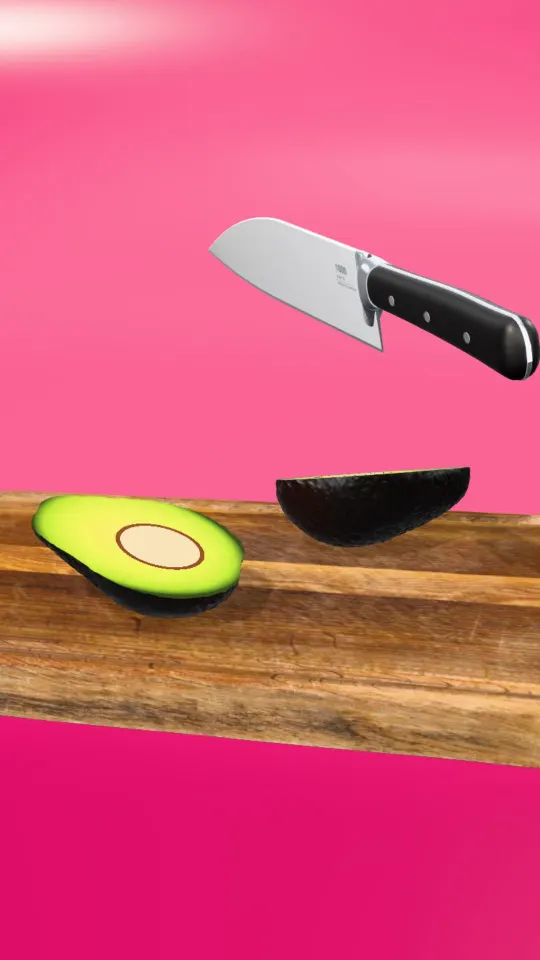
After 40 chops, the ⚡ meter fills and one tap unleashes 1,000 cuts, crumbling the fruit into a pile of tiny pieces. We did the maths on that in how many pieces can you cut an avocado into.
More real-kitchen guides
Our guide to cutting an avocado safely uses the same rule as this one: keep the food steady on the board, and keep your hand out of the knife's path. And if you want to know what makes a good game version of all this, read fruit cutting games: what to look for. The home page shows the game in action.
Frequently asked questions
Do you cut the root off an onion before dicing?
No. Trim off only the hairy roots and keep the root plate. It holds the layers together while you make your cuts, and you throw it away at the end.
Should you cut an onion with or against the grain?
For dicing, make your first cuts with the grain, from root to top, and then slice across them. The lines on the outside of the onion show which way the grain runs.
Does putting an onion in the fridge stop tears?
Probably not. The 2025 Cornell study found that the onion's starting temperature made no real difference to the mist it sprayed. A sharp knife and steady cuts helped much more.
Why do some onions make you cry more than others?
Onions differ in how much of the sulphur compounds they contain. Strong yellow and white onions usually sting more than mild sweet varieties, and no two onions are quite the same.
Sources
- Imai, S. et al. (2002). An onion enzyme that makes the eyes water. Nature 419, 685. nature.com/articles/419685a
- Wu, Z. et al. (2025). Droplet outbursts from onion cutting. PNAS. doi.org/10.1073/pnas.2512779122
Updated · By the 1000 Cuts team at DIGCY SARL AU