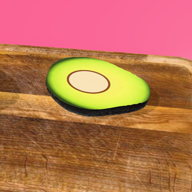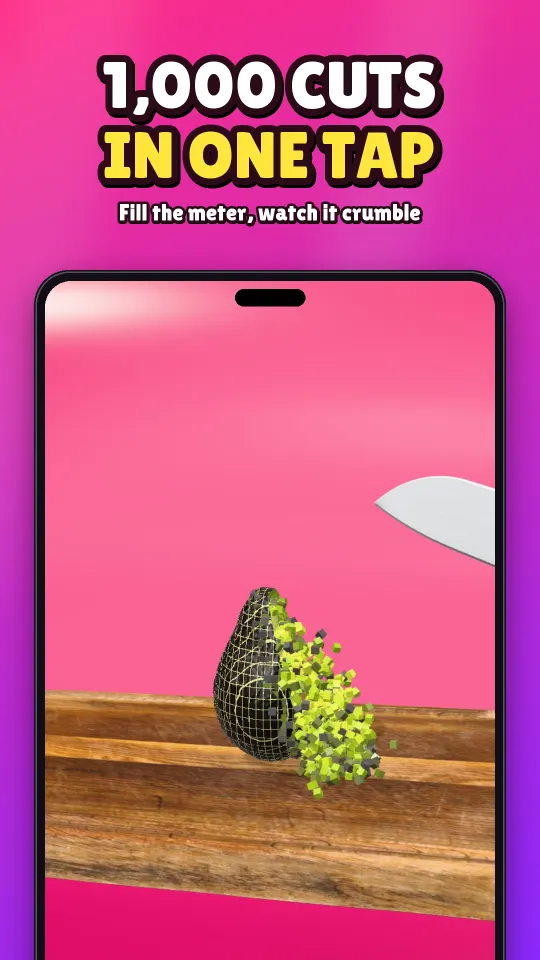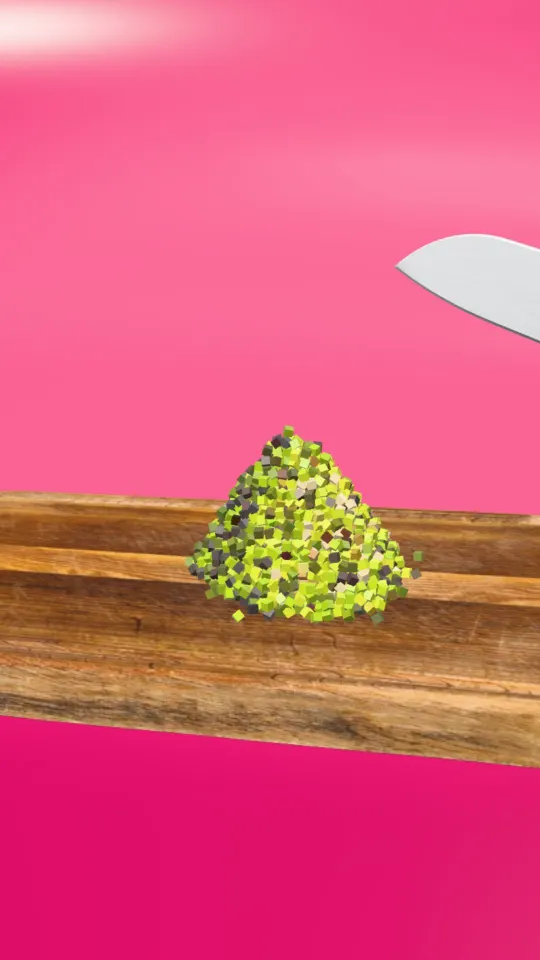
It is the question every "1 cut vs 1,000 cuts" video quietly raises. One cut gives you two halves; everybody knows that. But how many pieces do 10 cuts make? 100? And when the avocado on screen collapses into a green mountain after 1,000 cuts, is the counter at the bottom telling the truth?
There are three honest answers: the mathematical maximum, the neat dicing answer, and the real-kitchen answer. They are wildly different, and each one is interesting.
Answer 1: the mathematical maximum (cake numbers)
Mathematicians have solved this exact puzzle. Treat the avocado as a solid, convex shape (no pit for now). Every cut is a flat plane that goes all the way through, and you are not allowed to move pieces between cuts. What is the largest number of pieces n cuts can make?
The answer is a sequence called the cake numbers:
Maximum pieces with n cuts = (n³ + 5n + 6) ÷ 6
The trick is that every new cut should cross every previous cut, and never three at the same line. Then each new cut slices through as many existing pieces as possible.
| Cuts | Maximum pieces |
|---|---|
| 1 | 2 |
| 2 | 4 |
| 3 | 8 |
| 4 | 15 |
| 5 | 26 |
| 10 | 176 |
| 30 | 4,526 |
| 100 | 166,751 |
| 1,000 | 166,667,501 |
Notice the jump from 3 to 4 cuts. Three cuts at right angles make the classic 8 pieces. The fourth cut cannot split all 8 at once (a flat plane can only pass through 7 of them), so it adds 7, not 8, and you land on 15.
If you are slicing something flat, like a pizza, the 2D version is called the lazy caterer's sequence: (n² + n + 2) ÷ 2. Ten cuts across a pizza can make up to 56 slices. Add the third dimension and the number explodes, which is why an avocado can, on paper, become more than 166 million pieces.
Answer 2: dicing in a neat grid
Nobody in a kitchen cuts at random angles to hit the cake number. Real dicing uses parallel cuts in three directions: slices one way, then across, then flat. If you make a cuts along one axis, b along another and c along the third, you get:
Pieces in a grid = (a + 1) × (b + 1) × (c + 1)
For 1,000 cuts split as evenly as possible (333, 333 and 334), a box-shaped block would end up as 334 × 334 × 335 = 37,371,260 cubes. That is fewer than the cake number, but every piece is a tidy cube, and that is what the reels and games show.
An avocado is not a box, though. It is closer to an egg, and an egg-shaped solid fills only about half of the box around it (a perfect ellipsoid fills π/6, about 52%). So a 1,000-cut grid through a whole avocado lands somewhere around 17 to 20 million pieces. If you have seen the counter in a 1,000-cut avocado reel stop at around 17.6 million, that is where the number comes from.
Answer 3: what a real knife can do
Now the bad news. A real avocado is soft, small, and has a large pit in the middle.
A typical avocado has roughly 130 to 150 grams of edible flesh, which is about 130 to 150 cubic centimetres. Here is how many cubes that volume could make at different sizes:
| Cube size | Kitchen name | Rough number of cubes |
|---|---|---|
| 1 cm | medium dice | about 140 |
| 5 mm | small dice | about 1,100 |
| 3 mm | brunoise | about 5,000 |
| 1.5 mm | fine brunoise | about 40,000 |
| 1 mm | (not really possible) | about 140,000 |
In practice, ripe avocado squashes long before you reach brunoise. Most cooks dice it at 1 cm or larger, and even a very skilled chef with a firm avocado would struggle below 5 mm. So the honest real-world answer is: a few hundred pieces is normal, a few thousand is impressive, and millions are impossible with a knife.
The pit makes it harder still. You cannot cut through it with a normal kitchen knife, so every cut has to stop at it or go around it, and the flesh around the pit is a hollow shell rather than a solid. That breaks the neat maths above, which assumes a solid you can slice straight through.
Why the 1,000-cut version still feels right
If millions of pieces are impossible in a kitchen, why does the 1,000-cut pile feel so satisfying? Because it shows something you can only imagine. The maths says a fruit could become millions of pieces; the video, or the game, lets you watch it happen. We wrote more about that feeling in why fruit cutting videos are so satisfying.
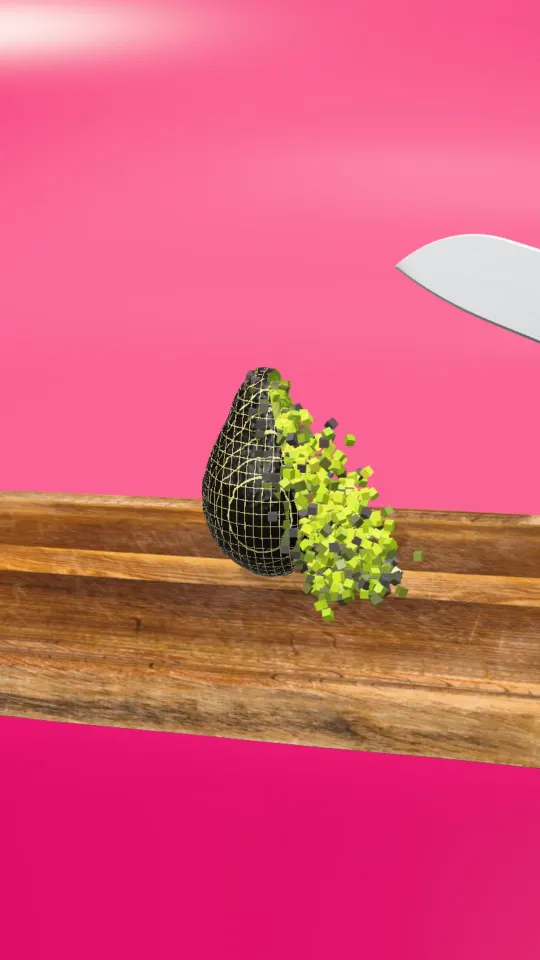
In 1000 Cuts, the ⚡ 1000 CUTS power uses the same grid idea. The 1,000 cuts are spread across three directions, the fruit is divided into a fine grid of cubes, and the piece counter is worked out from that grid and how much of it the fruit actually fills. The pile you see is drawn with fewer, larger cubes so it runs smoothly on a phone, while the counter shows the full number. Before the big moment, your own taps are real cuts: tap once and you get two halves, turn the board and cut across and the pieces multiply, exactly like the table above. The 1000 Cuts guide explains how the meter fills and what the challenge fruits ask for.
Quick maths you can try yourself
Want to impress someone at the chopping board? Here are three facts that hold for any solid fruit:
- Three cuts make at most 8 pieces. Cut down, cut across, then cut flat through the middle.
- Four cuts make at most 15, not 16. The fourth cut can only pass through 7 of the 8 pieces.
- Doubling the cuts multiplies the pieces by about 8 once the numbers get big, because the formula is dominated by n³. Ten times the cuts gives roughly a thousand times the pieces.
Frequently asked questions
How many pieces can you cut an avocado into with 1,000 cuts?
On paper, up to 166,667,501 pieces if every cut is placed perfectly (the cake number for 1,000). A neat 1,000-cut dicing grid through an avocado-shaped solid gives around 17 to 20 million. With a real knife and a real avocado, you would manage a few thousand at most.
What is the formula for the maximum number of pieces with n cuts?
For a solid, it is (n³ + 5n + 6) ÷ 6, known as the cake numbers. For a flat shape like a pizza, it is (n² + n + 2) ÷ 2, the lazy caterer's sequence.
How many pieces do 3 cuts make?
Up to 8 pieces in a solid, by cutting along three different directions. In a flat pizza, 3 cuts make up to 7 pieces.
What is the smallest you can dice an avocado?
Ripe avocado is too soft for very fine cuts. A 1 cm dice is standard, and around 5 mm is about as small as it holds its shape. Classic brunoise (3 mm) works for firm vegetables, not ripe avocado.
Is the piece count in 1,000-cut videos real?
It is calculated, not counted by hand. In reels and in 1000 Cuts, the number comes from the grid the 1,000 cuts create and how much of that grid the fruit fills. It is real maths for an idealised fruit; a real kitchen avocado could never get there.
Updated · By the 1000 Cuts team at DIGCY SARL AU