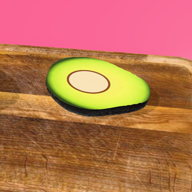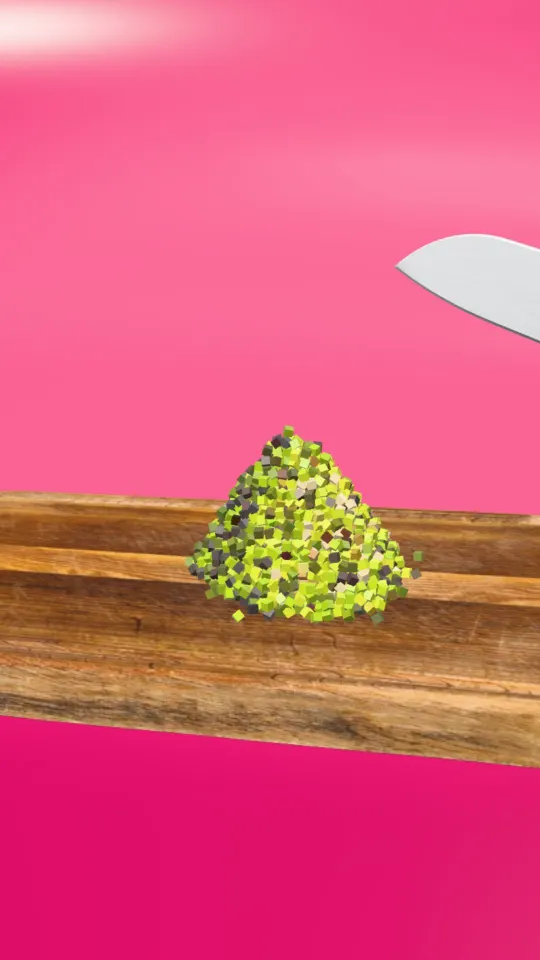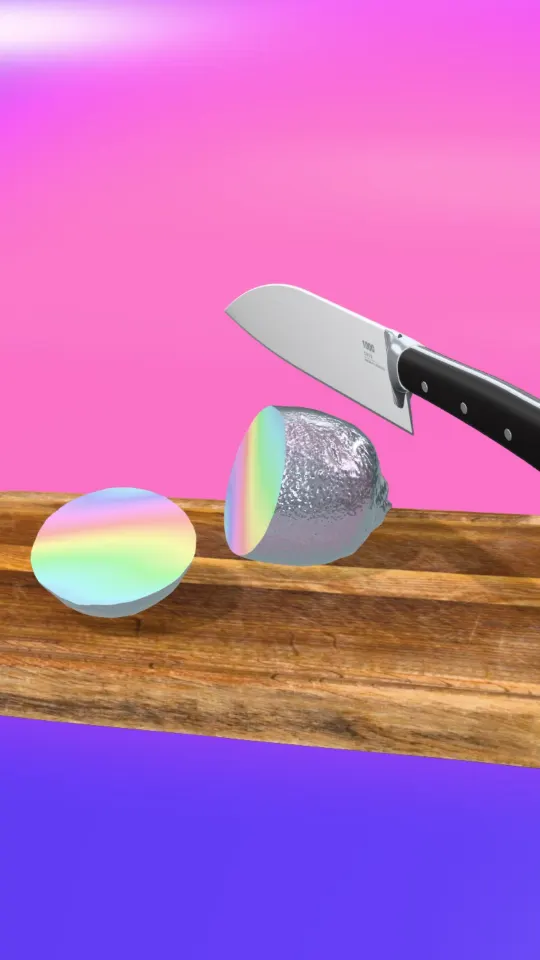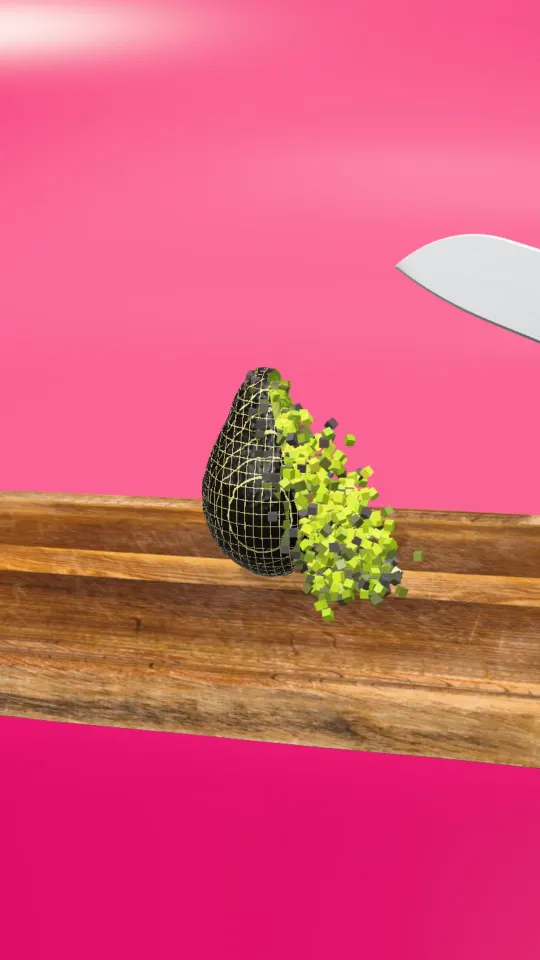
You know the video. A knife drops onto an avocado, there is a soft crunch, and two perfect halves fall apart. Then again, faster, until the avocado is a little green mountain. You meant to scroll past. You watched it three times.
Fruit cutting is one of the biggest corners of the "oddly satisfying" internet, and it overlaps with ASMR content. This article explains, in plain words, why these videos work, what ASMR is and is not, and why the "1 cut vs 1,000 cuts" format is so hard to look away from.
What makes a video "satisfying"?
A satisfying video is one where something happens exactly the way it should. A cake is sliced cleanly. Sand is cut into perfect cubes. Paint is mixed until the colour is even. Nothing goes wrong, and you see the whole thing from start to finish.
Most of our day is made of unfinished tasks and messy results. A satisfying video gives you a tiny, complete story in a few seconds: a thing, an action, a clean result, with nothing you need to do.
Fruit cutting fits that pattern almost perfectly, because fruit adds two extra ingredients: a great sound and a surprise inside.
Reason 1: the sound
Close your eyes during a good fruit cutting video and it still works. The sound carries a lot of it.
Every fruit sounds different. An apple gives a sharp, crisp snap. An avocado is a soft, buttery press followed by the knife tapping the board. A lime squeaks a little through its skin. An onion has that layered crackle. When the cuts come fast, those small sounds turn into a rhythm, and rhythm is easy to settle into.
This is also where fruit cutting meets ASMR. Crisp, close-up sounds are among the most common triggers people report, which is why many creators record with sensitive microphones and keep music out of the way. If you want to hear the difference, try the same clip with and without headphones.
Reason 2: precision and control
Watching a sharp knife go exactly where it is aimed is pleasing in itself. The movement is deliberate, the edge is clean, and the result is predictable. It is the opposite of the chaotic, rushed cutting most of us do in a real kitchen.
You can also predict every cut, and each prediction comes true. That steady loop of "expect it, see it" is a big part of why satisfying content feels calm rather than exciting.
Reason 3: the reveal
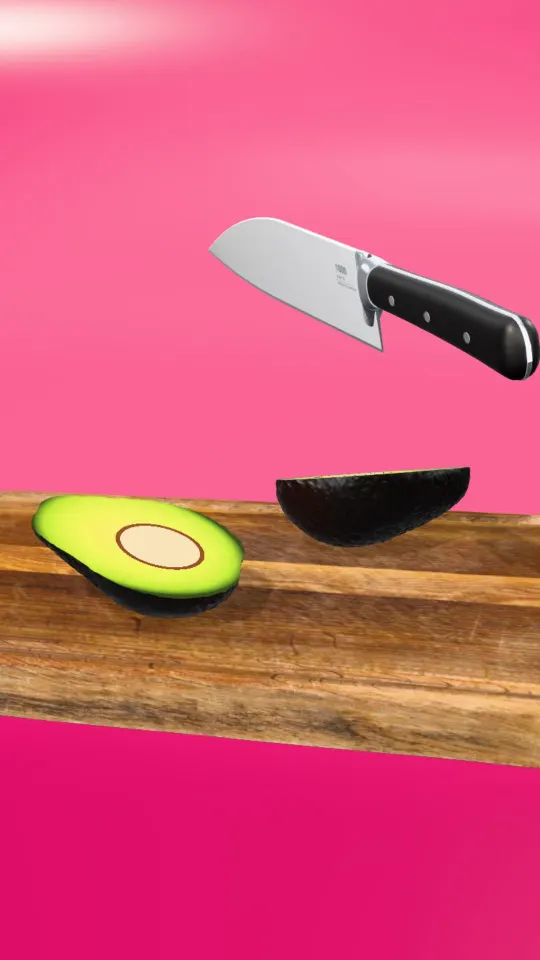
The outside of a fruit hides the inside. Every first cut is a small reveal: the bright green ring of an avocado around its pit, the starburst of a kiwi, the jewel-like seeds of a pomegranate, the rings of an onion. Even when you know what is coming, it is still a little moment of discovery.
Reason 4: completion, from whole to finished
The most satisfying videos have an ending you can feel coming. A whole fruit at the start, a neat pile at the end. The middle is a steady march between the two.
This is why many fruit videos end on the pile and hold there for a second. The pile is the "done" moment, the full stop at the end of the sentence. It is the same reason people enjoy watching a progress bar fill up or a cleaning video end on a spotless surface.
Reason 5: scale, and why "1 cut vs 1,000 cuts" works
The "1 cut vs 1,000 cuts" format adds one more hook: escalation. The video shows the same fruit cut once, then 30 times, then 100, then 200, 400 and finally 1,000. Each round answers a question you did not know you had: what does an avocado look like after 100 cuts? After 1,000?
Escalation turns a simple clip into a mini story with rising stakes. The first round is calm and familiar, two halves. The last round is something you have never seen in a kitchen, a fruit that collapses into a pile of millions of tiny pieces. You stay to see the ending because every round makes the ending bigger. (If you are curious how many pieces 1,000 cuts can really make, we did the avocado maths here.)
So what is ASMR, exactly?
ASMR stands for autonomous sensory meridian response. The name is newer than the feeling: the term spread online in the early 2010s as people tried to describe a pleasant, tingly sensation, often starting at the scalp and moving down the neck, that they felt when hearing whispers, soft tapping, crinkling or careful hand movements.
Research on it is still young, but it has started:
- In 2015, psychologists Emma Barratt and Nick Davis published one of the first studies of ASMR in the journal PeerJ, a survey of 475 people who experience it. Whispering, personal attention, crisp sounds and slow movements were among the most common triggers, and many respondents said they watched ASMR videos to relax or to help them fall asleep.
- In 2018, a team led by Giulia Poerio at the University of Sheffield published a study in PLOS ONE in which people who experience ASMR showed a lower heart rate while watching ASMR videos than people who do not, along with higher reported feelings of calm and connection.
Two honest caveats. First, not everyone feels ASMR tingles; plenty of people simply find the videos pleasant, and some find certain close-up sounds irritating. Second, these are early studies. They describe what people feel; they do not make ASMR a health product, and we do not claim it is one.
Watching vs. doing it yourself
Videos are passive: someone else picks the rhythm. In a game you hold the knife, choose where each cut lands and set the pace, and on a phone a small vibration on every cut adds a sense of touch that a video cannot.
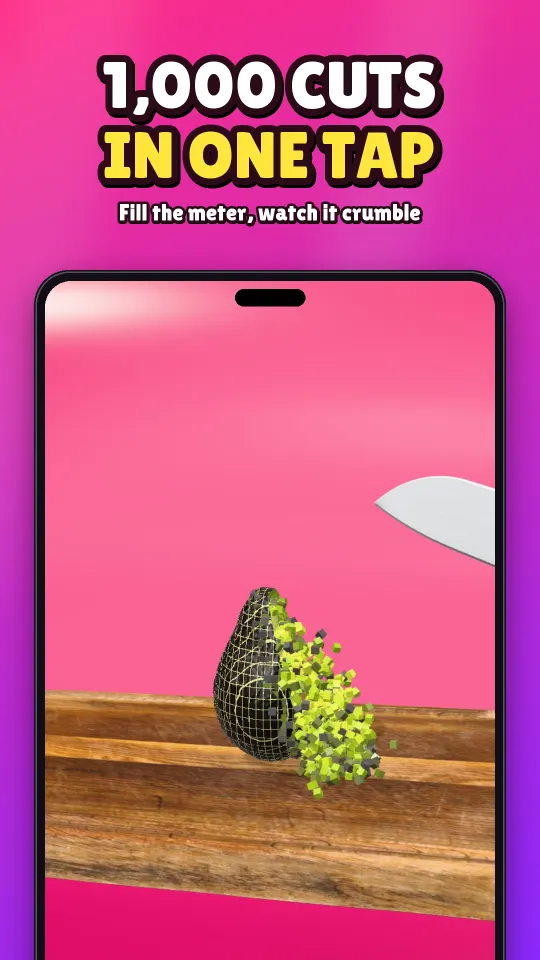
That is the idea behind 1000 Cuts, the game we make. It takes the "1 cut vs 1,000 cuts" moment from the reels and makes it playable: tap to chop exactly where you want, hold to chop fast, then fill the ⚡ meter and trigger 1,000 cuts at once to watch the fruit crumble into a pile. If you want to see how it works before trying it, the 1000 Cuts guide walks through every feature, and our list of the best ASMR games for Android covers other kinds of satisfying games too.
How to enjoy satisfying videos more
A few small things make a real difference:
- Use headphones. Most of the magic is in the sound, and phone speakers flatten it.
- Keep the volume low. ASMR sounds are meant to be close and quiet, not loud.
- Watch the whole round. The payoff is at the end; skipping to it loses the build-up.
- Pick a stopping point. One video, one round, one pile. Satisfying content is a snack, and it works best that way. If you are using it as a short break, our guide to satisfying games to relax has a simple five-minute routine.
Frequently asked questions
Is fruit cutting considered ASMR?
Often, yes. Fruit cutting videos with clear, close-up sound are a popular ASMR category, because crisp sounds are a common trigger. Without the sound focus they are usually just called "oddly satisfying" videos.
Why do I find fruit cutting videos so relaxing?
They are predictable, precise and complete: every cut does exactly what you expect, the inside is revealed, and the video ends on a neat finished result. The steady rhythm of the sound helps too. Some people also feel ASMR tingles from the sounds.
Why do some people dislike ASMR videos?
Not everyone experiences ASMR, and some people find close-up mouth or chewing sounds irritating rather than pleasant. Fruit cutting tends to work for more people because the sounds are crisp and mechanical rather than personal.
What is the "1 cut vs 1,000 cuts" trend?
It is a video format where the same fruit is cut once, then in escalating rounds (for example 30, 100, 200, 400) up to 1,000 cuts, when it crumbles into a pile. The escalation keeps you watching to see the final, biggest result.
Do I need headphones for ASMR?
You don't need them, but they help a lot. Much of the effect comes from quiet, detailed sounds that small phone speakers lose.
Sources
Barratt, E. L. and Davis, N. J. (2015), "Autonomous Sensory Meridian Response (ASMR): a flow-like mental state", PeerJ 3:e851. Poerio, G. L. et al. (2018), "More than a feeling: Autonomous sensory meridian response (ASMR) is characterized by reliable changes in affect and physiology", PLOS ONE 13(6): e0196645.
Updated · By the 1000 Cuts team at DIGCY SARL AU