Search for knife games for Android and you get a wall of icons with blades on them. They look alike, but they play very differently.
This guide sorts them into five kinds, explains where each idea comes from, and gives you a short checklist for choosing one. We make 1000 Cuts, a chopping game, so we say so where it comes up. Otherwise we stick to kinds of game rather than naming rivals.
What counts as a knife game?
A knife game is any game where the knife is the main tool, not just one weapon on a list. That leaves out shooters with a knife button and keeps the games built around one blade action: throwing, flipping, cutting, sharpening or stabbing between fingers.
| Kind | What you do | Skill it tests |
|---|---|---|
| Throwing | Tap to throw at a spinning target | Timing |
| Flipping | Swipe to flip a knife onto a surface | Touch and judgement |
| Chopping and slicing | Cut food or objects | Rhythm, sometimes aim |
| Sharpening and crafting | Grind, polish, forge a blade | Patience |
| Five finger fillet | Tap between fingers, faster and faster | Rhythm under pressure |
Knife throwing games: timing, not aim
Knife throwing games test timing. A log, a fruit or a wheel spins in the middle of the screen, you tap to throw, and a knife flies straight up and sticks. Hit a knife that is already stuck and the round ends. Fill the target and it shatters, then the next one spins faster or changes direction.
Real knife throwing is much harder, and that is why games simplify it. In a 2018 Popular Science guide, William Gurstelle explains that a thrown knife usually turns around its centre of gravity rather than flying point-first like a dart. You have to stand at a distance that gives a whole number of turns (or half turns, if you hold the blade), and release the same way every time. On a phone, all of that physics disappears. The knife always flies straight, so the whole game becomes "when do I tap?"
We covered how knife throwers fit among fruit games in our guide to fruit cutting games.
Knife flipping games: a pocket physics toy
Knife flipping games are about touch. You swipe to send a knife spinning into the air, and it has to land point-down in a table, a shelf or a block of wood. Swipe too hard and it overspins; too soft and it lands flat.
They feel close to the bottle flip trend: a small physical trick you repeat until you nail it. The better ones let the knife tumble with believable weight, so a near miss looks like a near miss and not a random failure. Look for games where you can tell why a flip went wrong.
Chopping and slicing games: you hold the knife
Chopping games let you cut, and the cut itself is the reward. Instead of hitting a target, you bring the knife down on food (or soap, or sand, or anything else) and watch it split. Good ones are less about winning and more about the sound and the look of each slice, which is why many sit close to ASMR. Our article on cutting ASMR sounds explains why a crisp chop feels so good.
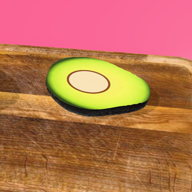
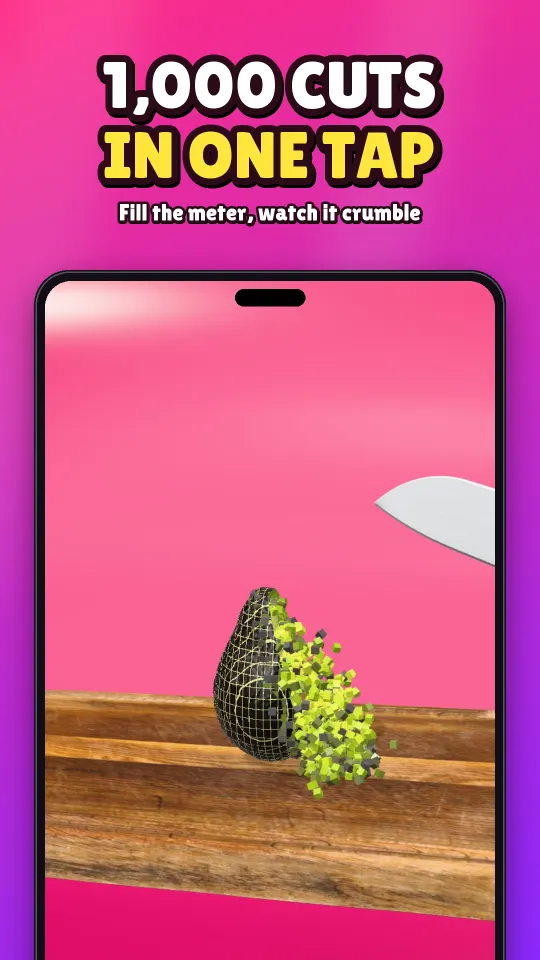
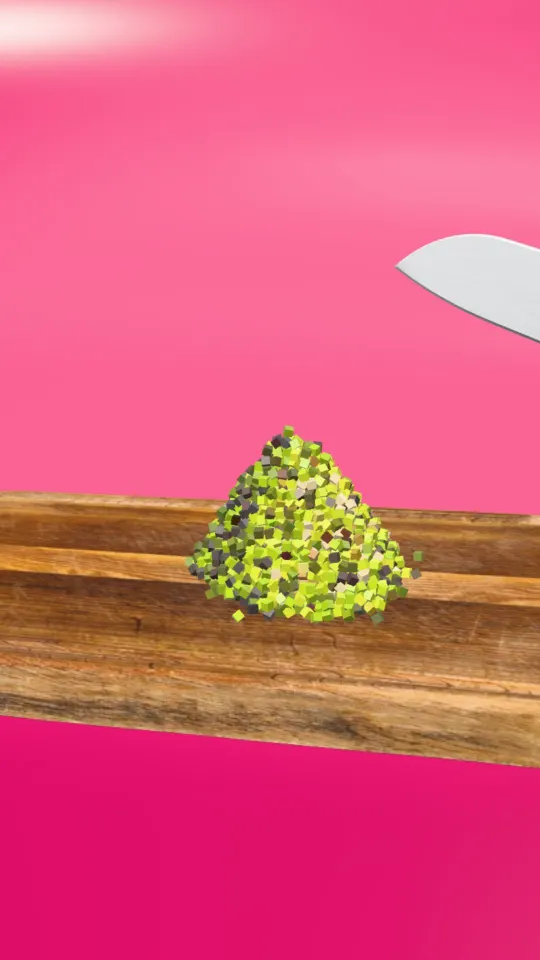
This is the kind we make. In 1000 Cuts, you tap to chop exactly where you touch on real 3D scanned fruit: avocado, kiwi, lemon, apple, lime, onion and pomegranate. Hold and drag to chop fast (it speeds up the longer you hold), and turn the board with ⟲ ⟳ or a two-finger twist to dice. After 40 chops the ⚡ meter is full, and one tap sends the knife through 1,000 cuts in a blur before the fruit crumbles into a pile.
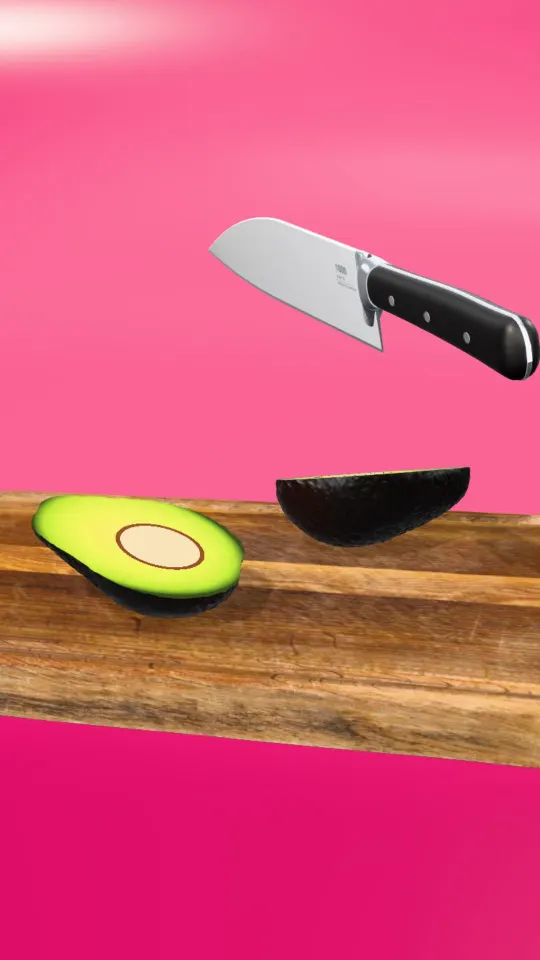
It is our take on the "1 cut vs 1,000 cuts" reels. The reels are rendered offline; the game is the real-time version.
Sharpening and crafting games: the slow kind
Sharpening and crafting games are about patience. You grind a blade on a whetstone, polish rust off an old knife, or forge and shape a new one step by step. There is little fail state; the fun is watching a dull, dirty object turn sharp and shiny.
They borrow from restoration videos. If you like slow progress you can see, this kind fits; if you want quick rounds, it may feel like homework.
Five finger fillet: the oldest knife game
Five finger fillet is the knife game that existed long before phones. A player spreads one hand flat on a table and stabs a knife back and forth in the gaps between the fingers, faster and faster. Wikipedia lists other names for it, including pinfinger, stabscotch and hand roulette, and notes it is dangerous on purpose: real players get hurt.
It shows up in films and games. Roman Polanski's Knife in the Water (1962) and Aliens (1986) both feature it, and Red Dead Redemption has a five finger fillet mini-game. A relative, mumblety-peg, was a pocketknife game where children tried to stick a knife in the ground; George Caleb Bingham painted boys playing it in 1852.
On a phone, it becomes a rhythm game: tap the gaps in order before the tempo outruns you. Please don't try it with a real knife.
How to choose a knife game on Google Play
The quickest way to choose is to decide which action you enjoy, then check a few things on the store page before you install.
- The age rating. It sits under the app title. Google Play says ratings are the responsibility of the developer and the International Age Rating Coalition (IARC), and reflect content like violence. Tap "Read more" to see why a game got its rating.
- The ads. Look for the "Contains ads" label and read recent reviews about how often ads appear. Our guide to games with too many ads has a five-minute test.
- The controls. Watch the store video. One-tap games suit quick breaks; swipe and hold games need a bit more attention.
- The sound. In chopping and sharpening games, sound is half the experience. Play with sound on for a minute before you judge.
- The price of cosmetics. Many knife games sell blades. Check whether new knives only look different or actually change the game. In 1000 Cuts, all 10 knives are cosmetic and cut identically, and you can see them in the knife shop.
Frequently asked questions
What are the main kinds of knife games?
There are five: throwing, flipping, chopping and slicing, sharpening and crafting, and five finger fillet style rhythm games. They share a blade but test different skills, from timing to patience.
Are knife games violent?
Most are not. Throwing, flipping and chopping games usually aim at logs, fruit or tables, not people. Check the age rating under the app title and tap "Read more" to see what the rating covers.
Is five finger fillet safe to play?
Not with a real knife. It is dangerous on purpose and people do get cut. Play a phone version instead, where the only thing at risk is your score.
Is 1000 Cuts a knife game?
Yes, it is a chopping game. You tap to chop real 3D scanned fruit, dice by turning the board, and unlock 10 cosmetic knives that all cut the same. It is on Android only, and it is not made for children under 13.
Sources
- William Gurstelle, Throwing knives is growing more popular, here's how to get started, Popular Science, 8 Oct 2018 (checked 21 Nov 2026)
- Wikipedia, Knife game (checked 21 Nov 2026)
- Wikipedia, Mumblety-peg (checked 21 Nov 2026)
- Google Play Help, Content ratings (checked 21 Nov 2026)
Updated · By the 1000 Cuts team at DIGCY SARL AU