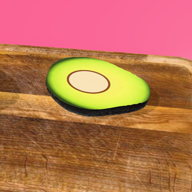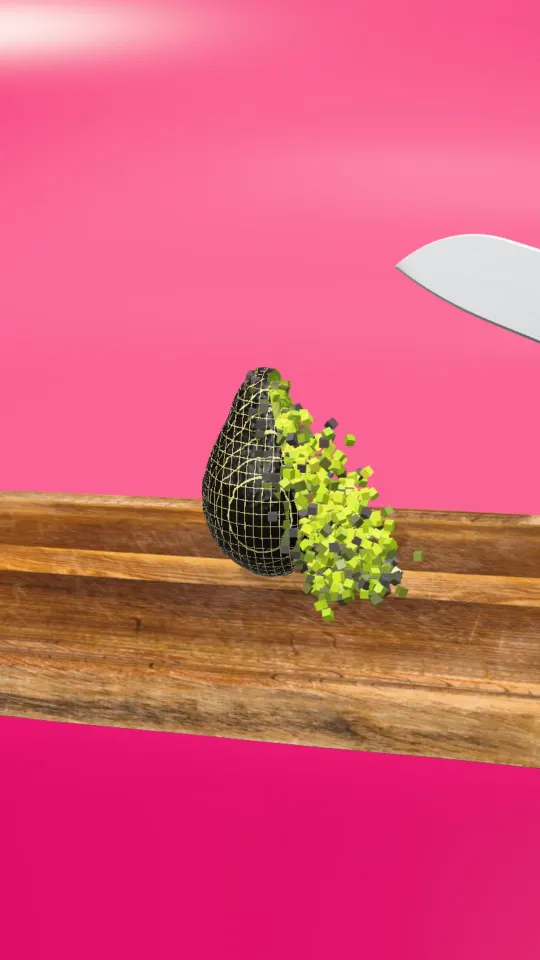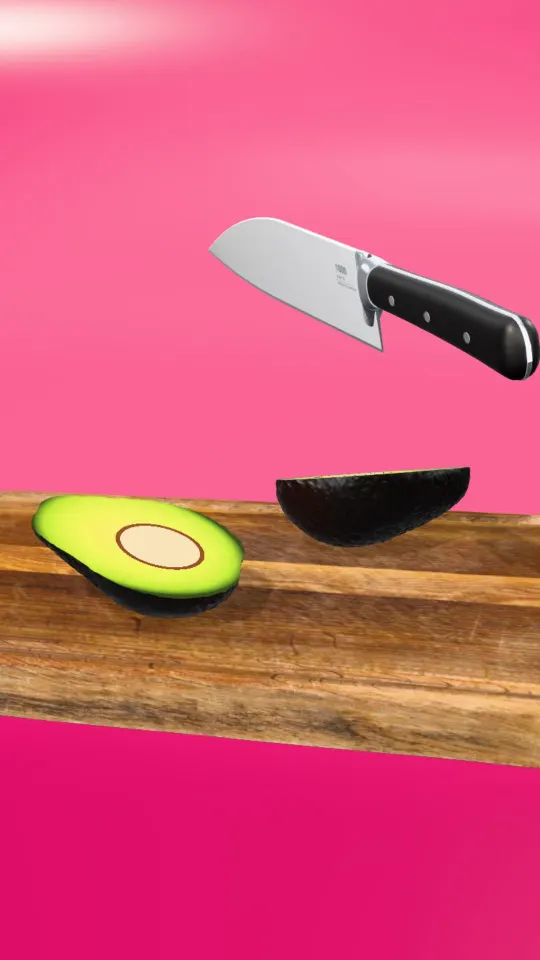
Cutting ASMR sounds are the quiet stars of every fruit slicing clip: the snap, the crunch, the soft tap of steel on wood. We make 1000 Cuts, a fruit slicer game built around recorded cutting sounds, so we wanted a straight answer to a simple question: why do these sounds feel so good, and why do they bother some people so much? Here is what research says, and where it stops.
What counts as a cutting ASMR sound?
A cutting ASMR sound is any close-up noise made by a blade going through food or another material, recorded quietly and played back without music. Most of them fall into a few families:
- The snap. A firm fruit like an apple splitting under the blade.
- The crunch. Many small pieces breaking at once, like pomegranate seeds.
- The tap. The knife reaching the board: the beat of fast chopping.
- The press. A soft, muffled cut through something buttery, like avocado.
- The scrape. The blade dragging across a surface (risky, see below).
New to the topic? Our guide to what ASMR is covers the tingles and common triggers.
Why do crisp, crunchy sounds feel satisfying?
Crisp sounds feel satisfying partly because our brains treat crispness as a sign of freshness. The best-known evidence is a 2004 study by Massimiliano Zampini and Charles Spence at the University of Oxford, published in the Journal of Sensory Studies. Volunteers bit into potato chips while hearing their own crunch through headphones, and the researchers secretly changed that sound.
When the crunch was made louder, or when only the high frequencies (2 to 20 kHz) were boosted, people rated the very same chips as crisper and fresher. The work later won a 2008 Ig Nobel Prize.
The lesson for cutting videos is simple: a bright, sharp crack tells your brain "this is fresh, this is crisp", even when you are only watching. That is why creators record so close to the food: close microphones catch the high, detailed part of the sound.
Why do some knife sounds feel awful?
Some knife sounds feel awful because scraping noises sit in a frequency range that most people find unpleasant. In a 2012 study in the Journal of Neuroscience, Sukhbinder Kumar, Tim Griffiths and colleagues at Newcastle University and the Wellcome Trust Centre for Neuroimaging in London played 74 short sounds to volunteers inside a brain scanner and asked them to rate each one. According to the university's summary of the results, the sound rated worst of all was a knife on a bottle, and bubbling water was rated the most pleasant.
The same summary says the most hated sounds clustered roughly between 2,000 and 5,000 Hz, a range where human hearing is very sensitive. The paper itself describes unpleasant sounds as having high frequencies, and found that the amygdala, a part of the brain involved in emotion, was linked to how unpleasant each sound felt.
So there is a fine line. A clean cut and a tap on wood are short and crisp; a blade dragged across glass is a long, squealing scrape. Good cutting ASMR keeps the first, which is one reason wooden boards are everywhere.
Rhythm: why fast chopping is easy to settle into
Fast chopping works because the sounds repeat in a steady, predictable pattern. Researchers who study ASMR note that common triggers "usually involve repetition of movements and/or sounds" (Fredborg, Clark and Smith, 2017, Frontiers in Psychology). Cutting is a perfect example: tap, tap, tap, with small changes as the pieces get smaller.
No study has tested rhythm in cutting videos directly, so treat this as a common pattern in what people enjoy, not a proven explanation.
Why do the same sounds annoy some people?
The same cutting sounds annoy some people because reactions to close-up sounds vary a lot from person to person. For some, sharp mouth and food noises cause a strong, angry reaction known as misophonia.
In a 2018 PeerJ study, Agnieszka Janik McErlean and Michael Banissy compared 64 people who reported ASMR with 68 who did not. The ASMR group scored higher on a misophonia questionnaire. The share above the clinical cut-off was higher too (36 percent vs 22 percent), but that difference was not statistically significant, and the study was small and based on self-report.
If cutting ASMR sounds make you tense instead of calm, mute the clip. If sounds cause you real distress in daily life, that is worth talking to a doctor about. A video or a game is not a treatment.
What does each fruit sound like?
Each fruit sounds different because of its skin, water and inside structure:
| Fruit | Main sound | What to listen for |
|---|---|---|
| Apple | Sharp snap | The crack as it splits, then a clean tap |
| Avocado | Soft press | A muffled cut, then the knife on the board |
| Lemon and lime | Squeak and spritz | The skin resisting, then juice |
| Onion | Layered crackle | Thin layers breaking one by one |
| Kiwi | Wet slice | A quiet cut through soft flesh |
| Pomegranate | Crunch | Many small seeds bursting at once |
For the whole clip, not just the sound, read why fruit cutting videos are so satisfying, and for how they spread, why satisfying videos go viral.
Hearing it vs making it yourself
Whatever you watch, use headphones: most of the crispness lives in high frequencies that phone speakers lose. Watching a cutting video gives you the sound; a game lets you choose when each cut happens.
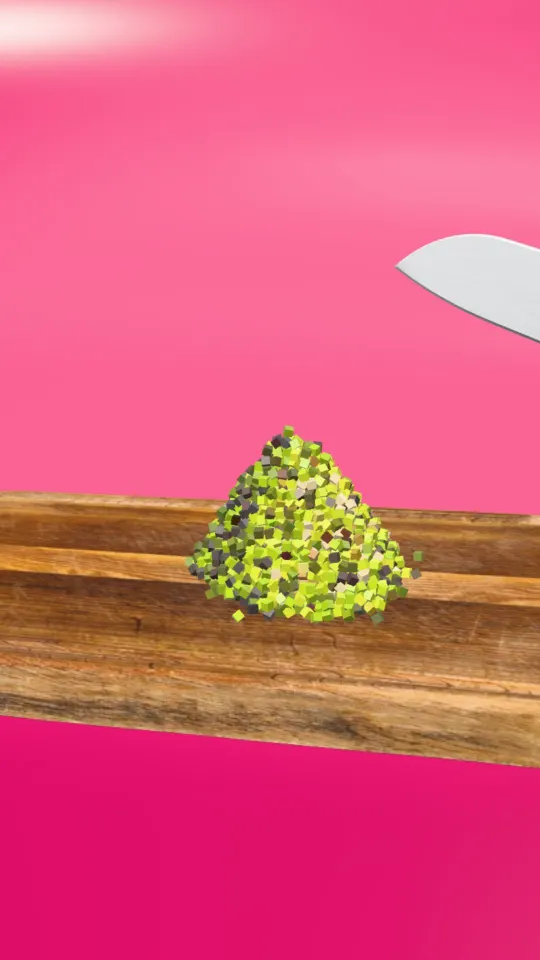
That is the idea behind 1000 Cuts, our fruit slicer game for Android. Tap and the knife chops exactly where you touched, with recorded knife-on-board sounds. Hold and drag to chop faster and faster. One honest note: the "1 cut vs 1,000 cuts" reels you may have seen from Physics Candy are rendered offline, while the game runs in real time on your phone, so it looks a little different.
Frequently asked questions
Why are cutting ASMR sounds so satisfying?
They are crisp, short and repeat in a steady rhythm. Research also shows crisp, high sounds make food seem fresher.
Why do some people hate crunching and cutting sounds?
Reactions to close-up sounds differ a lot between people. Some have misophonia, a strong negative reaction to certain sounds such as chewing or crunching. If a clip makes you tense, muting it is a perfectly good choice.
What is the most unpleasant knife sound?
In a 2012 Newcastle University brain-scan study of 74 sounds, a knife on a bottle came out as the most unpleasant, according to the university's summary. The worst sounds clustered between about 2,000 and 5,000 Hz, where human hearing is very sensitive.
Are cutting ASMR sounds good for sleep or anxiety?
Some people say they enjoy them as a way to wind down, but they are entertainment, not a treatment. If you struggle with sleep or anxiety, talk to a doctor or a mental health professional.
Sources
Zampini, M. and Spence, C. (2004), "The role of auditory cues in modulating the perceived crispness and staleness of potato chips", Journal of Sensory Studies 19: 347–363, neuroscience.ox.ac.uk. Kumar, S., von Kriegstein, K., Friston, K. and Griffiths, T. D. (2012), "Features versus feelings: dissociable representations of the acoustic features and valence of aversive sounds", Journal of Neuroscience 32(41): 14184–14192, PubMed Central PMC3505833, university summary at earthsky.org. Fredborg, B., Clark, J. and Smith, S. D. (2017), "An examination of personality traits associated with Autonomous Sensory Meridian Response (ASMR)", Frontiers in Psychology 8:247, PubMed Central PMC5322228. Janik McErlean, A. B. and Banissy, M. J. (2018), "Increased misophonia in self-reported Autonomous Sensory Meridian Response", PeerJ 6:e5351, PubMed Central PMC6084287.
Updated · By the 1000 Cuts team at DIGCY SARL AU