How many seeds are in a pomegranate? If you have ever tapped one out over a bowl, you have probably wondered. It feels like thousands. Some people will tell you it is exactly 613, every time.
The real answer is more interesting: there is no fixed number, but there is a pattern. Researchers have counted, and their numbers tell you roughly what to expect from the fruit in your hand. Here is what they found, where the 613 idea comes from, and how to count your own without losing an afternoon.
The short answer: usually 200 to 1,000
Most pomegranates hold somewhere between 200 and 1,000 seeds, and a typical one lands around 400 to 600.
The best numbers come from a 2011 study by Hazel Wetzstein and colleagues, published in HortScience. They harvested 48 pomegranates of the common 'Wonderful' variety, picked from flowers that opened at the same time, and measured everything: fruit weight, total aril weight and the number of arils in each fruit.
| Measured | Average | Range |
|---|---|---|
| Arils per fruit | 488 | 201 to 985 |
| Fruit weight | 345 g | 114 to 623 g |
| Aril share of weight | 50% | 40 to 58% |
| One aril | 357 mg | 226 to 469 mg |
So the "seedy" part is about half of the fruit by weight. The rest is the leathery skin and the pale, bitter membrane that holds everything in place.
Seeds or arils? The words people mix up
The red, juicy pieces you eat are called arils. Each aril is a seed wrapped in a sac of juice. When people say "pomegranate seeds", they almost always mean the arils.
In the same study, the hard white seed inside made up only a small part of each aril: about 33 mg out of 357 mg. Roughly 90% of an aril's weight was juice and pulp. That is why a single aril bursts so easily, and why one smashed aril can stain a white shirt.
Each aril starts as an ovule inside the flower, and each one needs its own successful fertilisation after pollination. More successful fertilisation means more arils, and that turns out to be the key to the whole question.
Do bigger pomegranates have more seeds?
Yes. Bigger pomegranates have more arils, not bigger arils.
This was the clearest result in the Wetzstein study. The number of arils per fruit tracked fruit weight very closely: the correlation was 0.86, where 1 would be a perfect match. But the average weight of a single aril had almost nothing to do with how many arils a fruit held (a correlation close to zero).
In plain words, a large pomegranate is not a small one with swollen arils. It is a fruit that simply packed in more of them. The researchers' own examples make it easy to picture: a 300 g fruit held about 480 arils, while a 550 g fruit held about 930.
That gives you a handy rule of thumb for 'Wonderful'-type fruit: roughly one and a half arils per gram of whole fruit. Weigh your pomegranate, multiply by 1.5, and you have a fair guess. Other varieties have smaller or larger arils, so treat it as a starting point, not a promise.
Where does "613 seeds" come from?
The 613 figure comes from Jewish tradition, not from counting. There are 613 commandments (mitzvot) in the Torah, and the pomegranate is an old symbol of being full of good deeds. Over time, the symbol turned into a "fact" that every pomegranate has 613 seeds.
Writer Ari Zivotofsky looked into it in his 2008 Jewish Action column, "What's the Truth about… Pomegranate Seeds?". His conclusion was that the classic rabbinic sources use the pomegranate as a picture of abundance and never state that it holds exactly 613 seeds. He also described an informal count of a couple of hundred fruits whose average was reported to land close to 613, and noted that the average kept shifting as more fruits were counted.
Either way, the counts above settle the practical question. A run of 48 fruits of one variety ranged from 201 to 985. No single number fits them all. A pomegranate can have 613 seeds, the same way a bag of rice can have exactly 10,000 grains: it happens, but it is not the rule.
How to count the seeds in your pomegranate
The fastest honest method is to weigh, count a sample, and multiply. It is the same shortcut scientists use, because counting 900 arils one by one is slow and easy to get wrong.
- Get the arils out. Score the skin, open the fruit in a bowl of water and push the arils free; the membrane floats and the arils sink.
- Drain and weigh all the arils. Write the total down in grams.
- Count a sample. Weigh out about 20 g and count those arils by hand.
- Scale it up. Divide the total weight by the sample weight, then multiply by your sample count.
Example: your arils weigh 180 g, and a 20 g sample has 56 arils. That is 180 ÷ 20 × 56 = 504 arils, right in the normal range. If a friend insists on 613, the full count is a fun way to settle it.
Pomegranates in 1000 Cuts
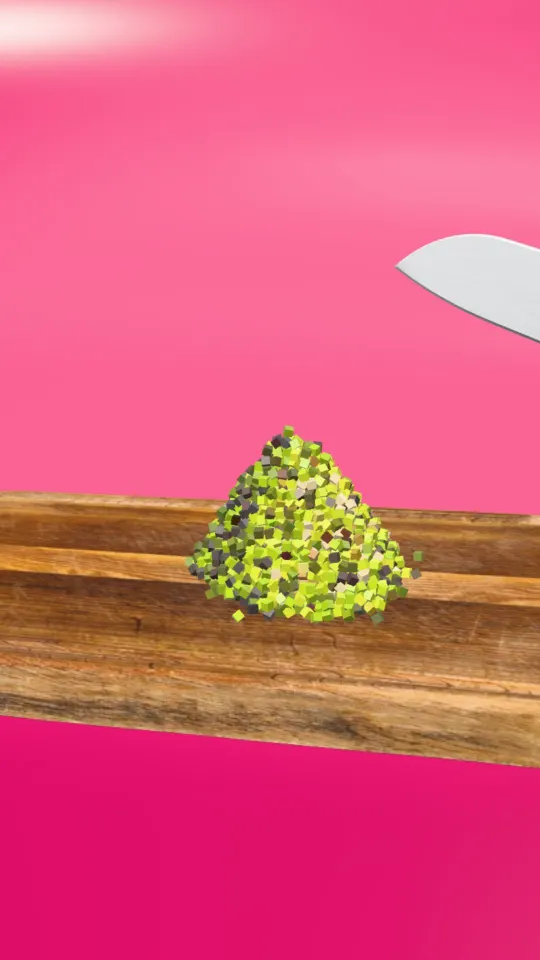
Pomegranate is one of the seven real 3D scanned fruits in 1000 Cuts, the fruit slicer game we make for Android, along with avocado, kiwi, lemon, apple, lime and onion. You tap to chop exactly where you touch, hold and drag to chop fast, and turn the board with ⟲ ⟳ to dice.
Every chop fills the ⚡ meter. After 40 chops, one tap sends the knife through 1,000 cuts in a blur and the fruit crumbles into a pile, with a piece counter that runs far past any real aril count. It is our real-time take on the "1 cut vs 1,000 cuts" reels; the reels are rendered offline, the game happens under your finger. The maths behind those huge piece counts is in how many pieces can you cut an avocado into, and the 1000 Cuts guide explains the meter and the challenge fruits.
If you like the moment a fruit opens and shows you its inside, the pomegranate is the best of the lot. We wrote about why that reveal feels so good in why fruit cutting videos are satisfying.
Frequently asked questions
Does every pomegranate have the same number of seeds?
No. In one study of 48 pomegranates of the same variety, the count ranged from 201 to 985 arils. The size of the fruit explained most of the difference.
Do all pomegranates have 613 seeds?
No. The 613 figure comes from Jewish tradition, where the pomegranate symbolises the 613 commandments. Counts of real fruit vary by hundreds, so a pomegranate with exactly 613 seeds is a coincidence, not the rule.
Are pomegranate seeds and arils the same thing?
Almost. An aril is the juicy red sac you eat, and each one has a small hard seed inside. Most people say "seeds" when they mean the whole aril.
Do bigger pomegranates have more seeds?
Yes. In the study, larger fruit held more arils, while the size of each aril stayed about the same. A 550 g fruit had roughly twice as many arils as a 300 g fruit.
What is the quickest way to count pomegranate seeds?
Weigh all the arils, count the arils in a small weighed sample such as 20 g, and scale up. It takes a few minutes instead of an hour and is accurate enough to settle any argument.
Sources
- Wetzstein, H.Y., Zhang, Z., Ravid, N. and Wetzstein, M.E. (2011). Characterization of attributes related to fruit size in pomegranate. HortScience 46(6): 908–912. journals.ashs.org
- Porter, J. and Wetzstein, H.Y. The biology of pomegranates: all about flowers, fruit and arils (presentation summarising the study data). growables.org
- Zivotofsky, A. (2008). What's the truth about… pomegranate seeds? Jewish Action, Fall 2008. jewishaction.com
Updated · By the 1000 Cuts team at DIGCY SARL AU