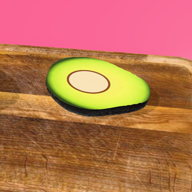
If you have watched a perfect 3D slicing clip and then opened a fruit slicer game, you may have noticed the game looks a little different. That is the real-time vs pre-rendered gap, and it is not laziness or a trick. It is a hard limit set by the clock.
We make 1000 Cuts, a real-time fruit slicing game, so we deal with this trade-off every day. We will keep it honest.
What is the difference between real-time and pre-rendered?
Pre-rendered means the images are computed in advance and played back later, like a film. Real-time means the computer draws each image the moment it is needed, usually in response to what you just did.
A pre-rendered video, also called offline rendering, has no deadline. If a frame takes ten minutes, the finished file still plays smoothly.
A game cannot work like that. It does not know where you will tap next, so it cannot draw the frame in advance. It has to react, draw and show the result before the next frame is due.
| Pre-rendered (offline) | Real-time | |
|---|---|---|
| When frames are made | Before you watch | While you play |
| Time per frame | Seconds to hours | About 16.7 ms at 60 fps |
| Can it react to you? | No, it is fixed | Yes, every frame |
| Light | Usually path traced, physically accurate | Usually rasterized, approximated |
| Typical use | Films, satisfying 3D clips, cutscenes | Games, VR, 3D previews |
The frame budget: why time is everything
A frame budget is the time a game has to make one image. At 60 frames per second, that is 1,000 ms divided by 60, or about 16.7 milliseconds. At 30 frames per second it is about 33.3 ms.
Now compare that with film. In 2013, Pixar's supervising technical director Sanjay Bakshi told GamesBeat that a single frame of Monsters University took 29 hours to render on average, on a render farm with more than 24,000 cores. Twenty-nine hours is about 104,400 seconds. Divide that by 0.0167 seconds and you get roughly six million times more time per frame than a 60 fps game gets.
A satisfying Blender clip is far lighter than a Pixar film, but even a few minutes per frame is thousands of times more than a game gets. And the game shares its 16.7 ms with everything else: reading your touch, running physics, playing sound and updating the score.
Rasterization vs path tracing: two ways to draw light
Most real-time graphics use rasterization; most high-end offline renders use path tracing. That is the second big difference after time.
Path tracing follows rays of light as they bounce around a scene, picking up colour from every surface they touch. It gives soft shadows and realistic reflections, but it is slow, because it needs many rays per pixel.
Rasterization works the other way round. It works out which surface is visible at each pixel and then estimates the lighting with clever shortcuts. The Blender Manual puts it plainly: its real-time engine EEVEE "is based on rasterization and is not a path tracer", and the path tracer Cycles will always give more physically accurate renders. Same software, same scene, two very different results.
The line has started to blur. NVIDIA announced real-time ray tracing for games with its RTX graphics cards in August 2018, and big PC and console games now mix some ray-traced effects into rasterized frames. But on most phones, full path tracing at 60 fps is still out of reach.
Physics: simulated once vs simulated live
In a rendered clip, physics is simulated once, checked, and re-run until it looks perfect. In a game, physics runs live, inside the frame budget, every single time.
If a slice lands badly, the video maker simply simulates again. Our guide to how satisfying 3D videos are made walks through those rounds of re-simulating and re-rendering.
A game gets one take, and it is yours. Where you cut, how fast, and how many pieces there are all change from play to play. So game physics has to be fast and stable rather than perfect.
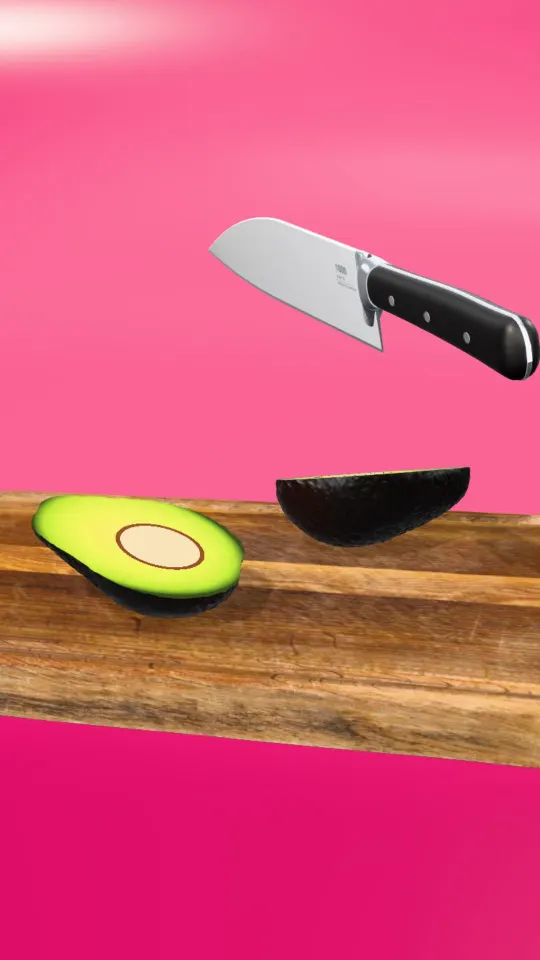
Why trailers and ads often look better than the game
Trailers and ads can look better than gameplay because they are often pre-rendered or captured with settings the average device cannot run. A cutscene or ad made as a video can use offline rendering, so it has none of the game's limits.
Pre-rendered cutscenes exist for this reason, and that is fine when it is clear what is video and what is game. It becomes a problem when an ad suggests the game itself looks or plays like the clip.
Why phone games have it hardest
Phones have the smallest budget of all: less power than a PC or console, a small battery, and no fan. When a phone gets hot, it slows its own chips down to cool off, which is called thermal throttling.
Android's developer site shows how much this matters. In a case study, Netmarble reported that without the Android Adaptive Performance Framework (ADPF), one game's frame rate could swing from about 40 to 56 fps because of thermal throttling. With them, the game lowered its target early and stayed mostly in the 50 to 60 range.
So mobile games pick their battles: fewer lights, simpler shadows, and detail spent where your eyes actually are.
Real-time vs pre-rendered in 1000 Cuts
The Physics Candy "1 cut vs 1,000 cuts" reels are rendered offline, frame by frame. 1000 Cuts is the real-time version, a fruit slicer game for Android, and it plays by real-time rules: every chop is drawn the moment you make it.
That trade gives you something a video never can. The fruit is real 3D-scanned avocado, kiwi, lemon, apple, lime, onion and pomegranate. Tap to chop exactly where you touch, hold and drag to chop fast, and twist the board with ⟲ ⟳ to dice. Fill the ⚡ meter with 40 chops, tap it, and you trigger 1,000 cuts in a blur that crumbles the fruit into a pile. It will not look exactly like a render, but the pile is yours, and it is different every time.
If you are curious why these clips grab so many viewers in the first place, read why satisfying videos go viral, or see the game itself.
Frequently asked questions
Is pre-rendered better than real-time?
Not better, just different. Pre-rendered graphics usually look more realistic because each frame has far more time, but they cannot react to you. Real-time graphics trade some realism for interactivity.
Why do games not look like CGI movies?
Because a game must draw each frame in about 16.7 milliseconds at 60 fps, while a film can spend minutes or hours per frame. Games use faster approximations of light and physics to hit that deadline.
Are cutscenes pre-rendered?
Some are and some are not. Pre-rendered cutscenes are videos played back by the game, while real-time cutscenes are drawn by the game engine as they play.
Why does my phone game slow down after a while?
Usually because the phone is getting hot. To cool down it lowers its chip speeds, called thermal throttling, and a game that does not adapt will drop frames.
Sources
Blender Manual, "Render Engines" and "EEVEE: Introduction", docs.blender.org. Takahashi, D. (2013), "How Pixar made Monsters University, its latest technological marvel", GamesBeat. NVIDIA (20 August 2018), "NVIDIA RTX Platform Brings Real-Time Ray Tracing and AI to Barrage of Blockbuster Games", nvidianews.nvidia.com. Android Developers, "Netmarble Games: Optimizing Performance with ADPF", developer.android.com. All checked 20 November 2026.
Updated · By the 1000 Cuts team at DIGCY SARL AU